
How can SaaS documentation become easier for ChatGPT, Claude and Perplexity to cite?
Help AI search tools find clear, accurate SaaS documentation. Separate crawler access from citation results and use a repeatable check across engines.

Provider guidance checked on 6 October 2026. Published by HelpDesky. This is a practical editorial and evaluation framework for SaaS founders, not a claim that we have measured citation improvements. Examples below are illustrative.
What does it mean for an AI answer to cite your documentation?
A citation is a link presented as support for an answer. That is different from your brand appearing in a sentence, a crawler visiting your server or someone clicking through to your website. Treat these as separate observations.
For a SaaS business, the useful outcome is not simply being mentioned. You want a prospective customer to receive an accurate explanation, find the relevant source and understand whether your product fits. A citation to an obsolete pricing page can be less useful than no citation at all.
Start with a small set of questions your public documentation should answer. Include product capabilities, important limitations and common buying concerns. Keep private account issues in private support. Our guide to choosing a small SaaS support setup explains how public knowledge and human conversations fit together.
Which access checks matter for each provider?
Search discovery and model training are separate purposes. Do not copy a blanket bot policy without understanding which activity each setting controls. Ask whoever manages your website to check the current provider guidance, the relevant documentation hostname and any firewall rules.
- ChatGPT search: OpenAI identifies
OAI-SearchBotas its search crawler andGPTBotas a crawler for content that may be used in model training. Its crawler documentation describes independent controls and recommends permitting the search bot and its published IP ranges for search visibility. - Claude: Anthropic distinguishes
Claude-SearchBotfor search,Claude-Userfor retrieval initiated by a user, andClaudeBotfor potential training collection. Its crawler policy explains how restrictions affect each purpose. - Perplexity: Its crawler reference identifies
PerplexityBotas a search bot, distinct from its user request fetcher. It recommends checking both crawler permissions and published IP ranges; a firewall can prevent access even when the robots policy permits it.
These are access checks, not a citation formula. A successful page load in your browser does not prove that every crawler can retrieve it. Conversely, one missing citation does not prove that access is blocked. Diagnose those questions separately, using the provider guidance and your server evidence.
Keep access restricted for information that should remain private. Publish a general explanation of a feature or policy instead of exposing customer records in the hope of improving discovery.
What makes a documentation answer useful as a source?
Think about the person who opens the source to check a claim. Can they quickly establish the answer, the product it applies to and the exceptions? The same editorial discipline gives an answer system clearer material to work with, although it is not proof of a ranking benefit.
Compare two fictional examples for a product called Acme:
Vague: Acme makes exporting easy with powerful options for every team.
Specific: Workspace owners can export the customer list as CSV. The export includes active and archived customers. It does not include uploaded attachments. Contact support if you need an attachment export.
The second version answers who can act, what is included and what is excluded. It is a writing example, not a statement about HelpDesky. Before publishing an answer like this, verify every detail against the actual product.
- Give the direct answer early. Follow it with the context needed to use it correctly.
- Name the scope. State relevant plans, roles, regions or versions rather than relying on an implied context.
- Explain meaningful limits. A limitation next to the benefit is easier to evaluate than one hidden on an unrelated page.
- Show responsibility and freshness. Use accurate authorship or ownership and a meaningful review date. Do not change the date without checking the content.
- Support claims. Link to the governing product reference or primary source, particularly for changing limits or external integrations.
Use descriptive headings and readable text alongside useful screenshots. An image can demonstrate a control or result, but the surrounding explanation should still communicate the important fact. Avoid creating several nearly identical pages for slight variations of the same question.
Do you need special AI formatting?
Do not turn a clear customer explanation into a rigid collection of keywords. Google’s guidance for generative AI features in Search emphasises useful original content and established SEO practices. It says there is no special schema markup required for those features. That guidance concerns Google Search; it is not evidence that every other system works identically.
For founders, the practical priority is a dependable public source: stable URLs, meaningful titles, sensible navigation and content that remains understandable when opened directly. Descriptive internal links help readers find related explanations without making one article cover every topic.
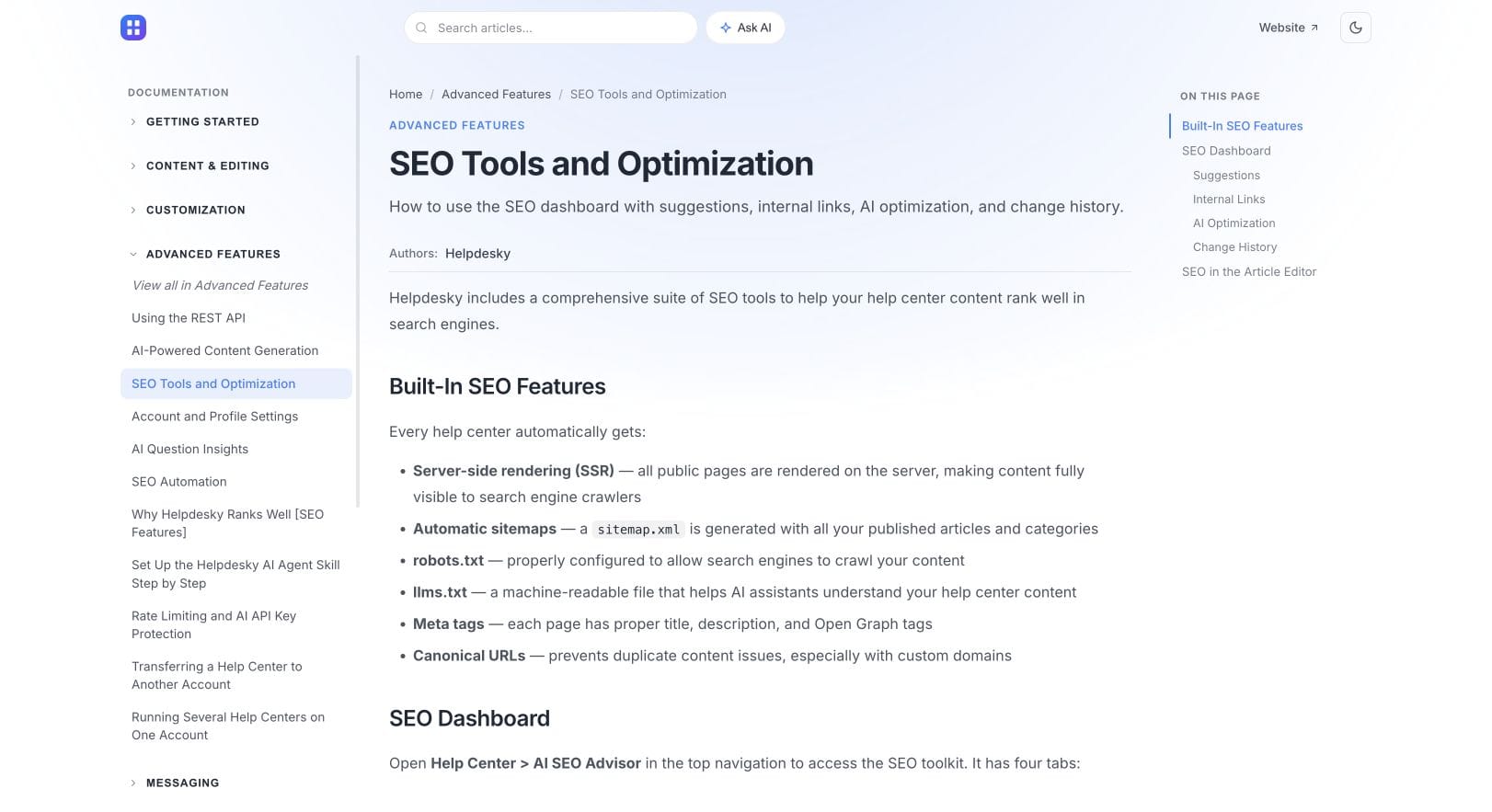
HelpDesky’s documented publishing features include server rendering, sitemaps, metadata and canonical URLs. These provide a foundation for public documentation. Their presence alone does not establish that an AI service has selected or cited a page.
For background on discovery and fetching, this Google Search Central video explains how Google crawls pages. It is useful technical context, not a description of how ChatGPT, Claude or Perplexity select citations.
How can you check citations without fooling yourself?
Use a repeatable observation log instead of judging one impressive answer. Choose a modest set of real customer questions and keep the wording stable while you compare runs. Include questions that name your product and broader questions where it could reasonably be relevant. Record those groups separately.
- Record the conditions. Save the date, exact question, engine, available model or mode, and whether web search was used. Use a fresh conversation and note relevant account or location context.
- Inspect the actual source links. Record the cited URL and the specific statement it supports. A brand mention without a link is a different result.
- Open the source. Check that it loads, refers to the correct product and supports the statement. Note outdated pages, wrong versions or missing qualifications.
- Repeat after a meaningful change. Record what changed in your documentation and allow for discovery delays. Keep unsuccessful observations as well as successful ones.
- Review customer value. If referral visits occur, consider whether people find the answer or take a useful next step. Citation presence and conversion are different measures.
Keep prompted retrieval separate from discovery. Asking an engine to read a URL you supplied tests that interaction; it does not demonstrate that the engine would have found and cited the page unaided.
For example, a log entry might say: “Product limits question; web search used; cited an old plan page; answer omitted the export restriction.” That gives your team a concrete editorial issue to investigate. It is more actionable than declaring an entire brand invisible from one response.
For Google’s AI search experiences and Copilot, maintain separate observations and consult their current platform guidance. Do not combine all engines into an unsupported universal visibility score. Search Console data can inform your search work, but it does not establish citation performance in ChatGPT, Claude or Perplexity.
Which documentation improvements should come first?
Fix consequential inaccuracies before expanding the library. If a page misstates a limit, update the source and check related pages that repeat it. If customers cannot find an existing answer, improve its wording and relevant internal links. If the answer is genuinely missing, create one focused explanation.
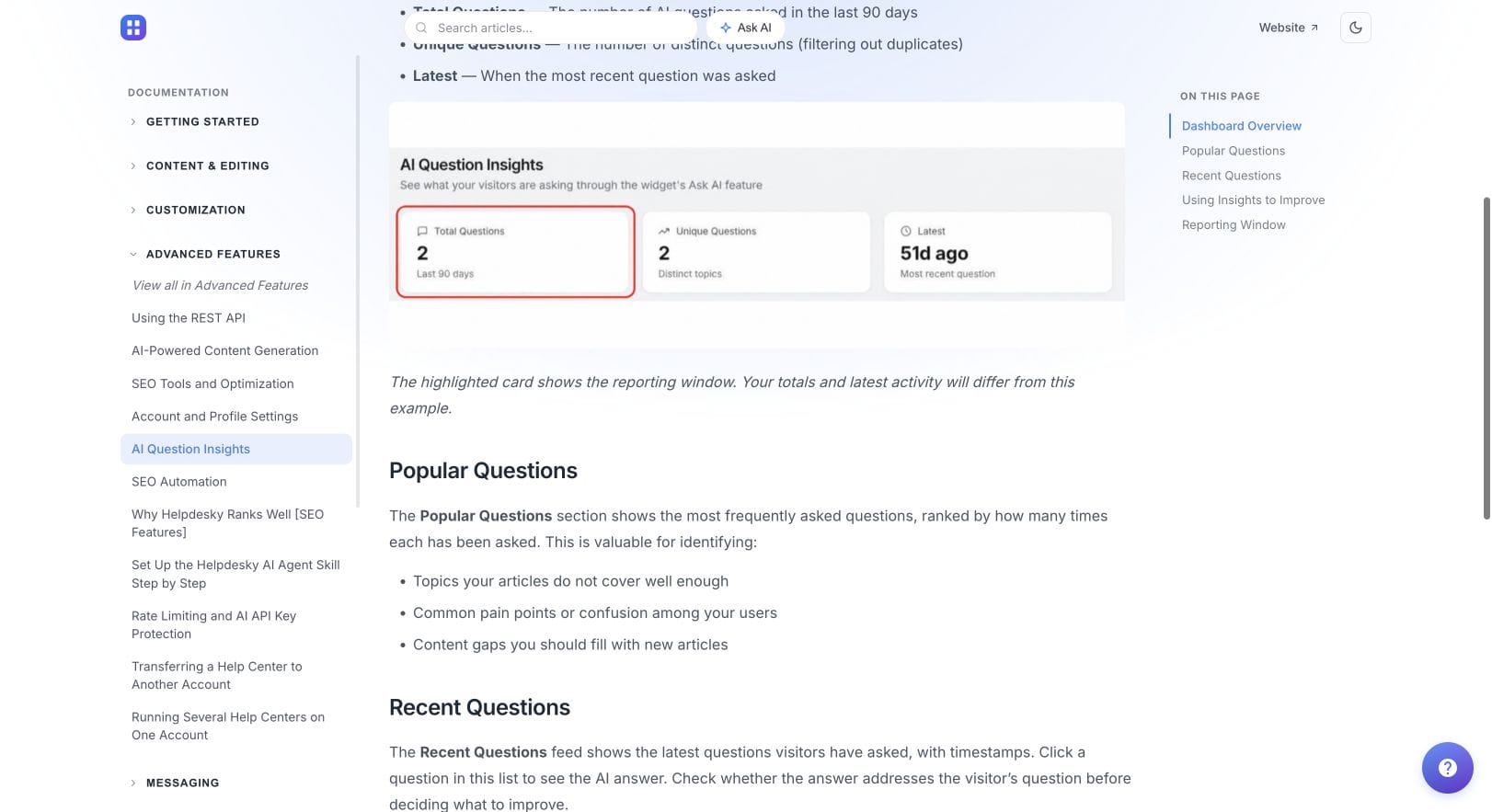
HelpDesky’s AI Question Insights documentation describes how widget questions can reveal gaps and unfamiliar customer terminology. That is evidence about your own visitors’ questions, not a report of citations from external AI engines.
Assign an owner to each important answer and review it when the product changes. Keep a small change log beside your citation observations so you can distinguish a factual correction from a formatting experiment. Avoid claiming that a later citation was caused by your edit without stronger evidence.
If your team needs a public help centre connected to customer support, HelpDesky is a practical option to evaluate. Start with a handful of accurate answers and test the whole reader journey. If those answers need a human follow up, our guide to forms, AI chatbots and ticket portals helps you choose the next step.
Build a source your customers can trust. Evaluate a public help centre with clear answers, useful navigation and a route to your support team.
Frequently asked questions
Does allowing a search crawler guarantee a citation?
No. It addresses access. Whether a service selects a page as a source is a separate question that you must observe rather than assume.
Must I allow model training to appear in search?
Do not treat those permissions as interchangeable. OpenAI and Anthropic document separate agents for search and potential training collection. Review the current controls for each provider.
Should we publish private support tickets for AI discovery?
No. Keep customer conversations private and write a separate reusable explanation when a recurring issue deserves public documentation.
Does our widget’s AI activity measure external citations?
No. Questions asked inside your widget describe that channel’s activity. Check citations in external services separately.
Should every answer become a separate article?
No. Give a distinct customer problem a clear home. Closely related qualifications can belong in the same page rather than becoming repetitive articles.
How quickly should we expect results after an edit?
There is no reliable deadline for earning a citation. Record the edit date, check access and repeat your observations without presenting a single changed result as proof of improvement.