Bring your own AI key or pay per resolution: which costs less?
Work out what your support AI really costs: compare provider usage, billable outcomes, flat platform fees and the human work left after an answer.
The useful question is not whether a token costs less than a resolution. They measure different things. Compare the money spent handling the same set of customer questions, then check how many were answered correctly and how much work remained for your team.
What are the starting costs for five people?
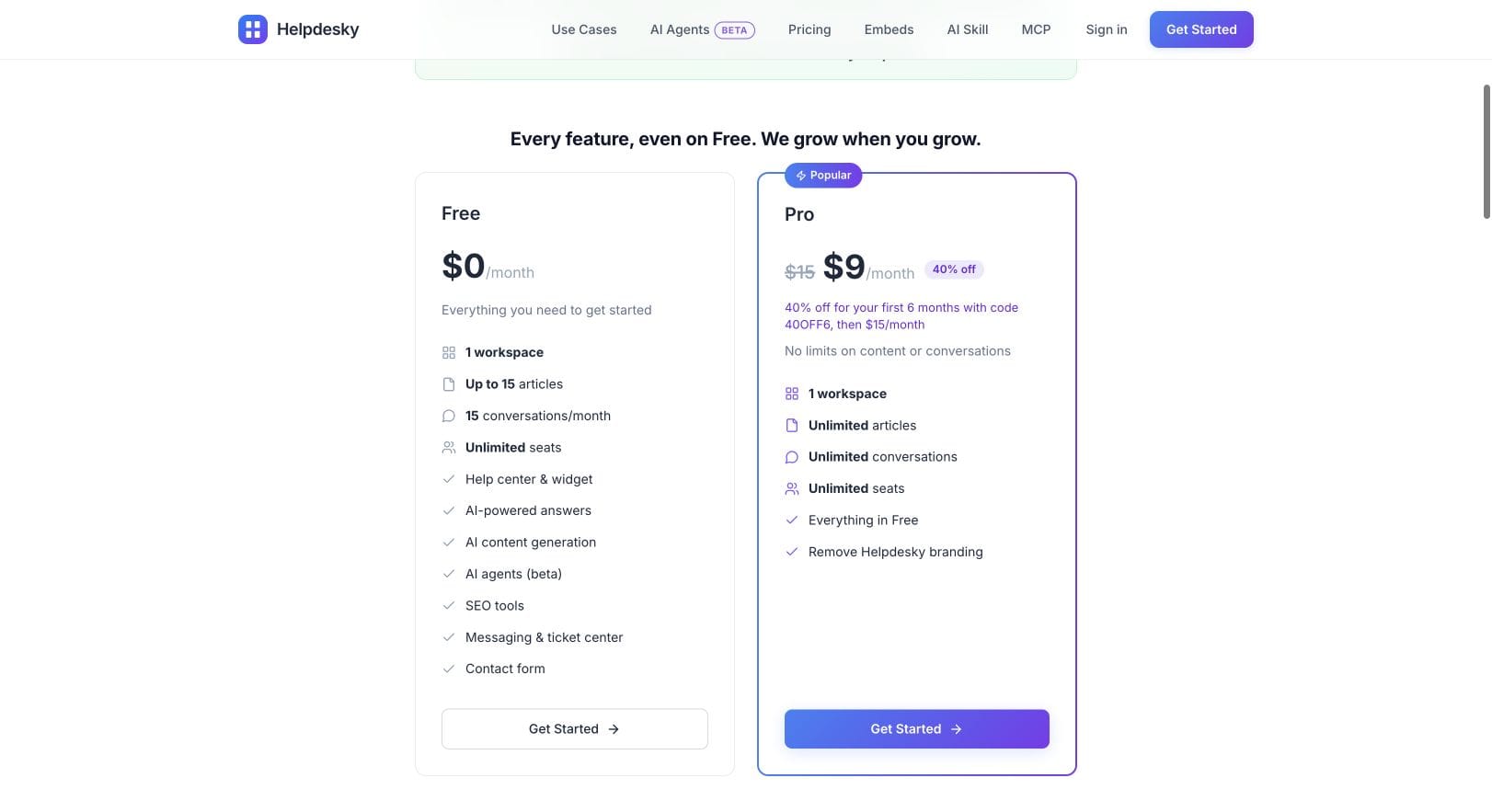
| Monthly cost | HelpDesky Pro | Intercom Essential with Fin |
|---|---|---|
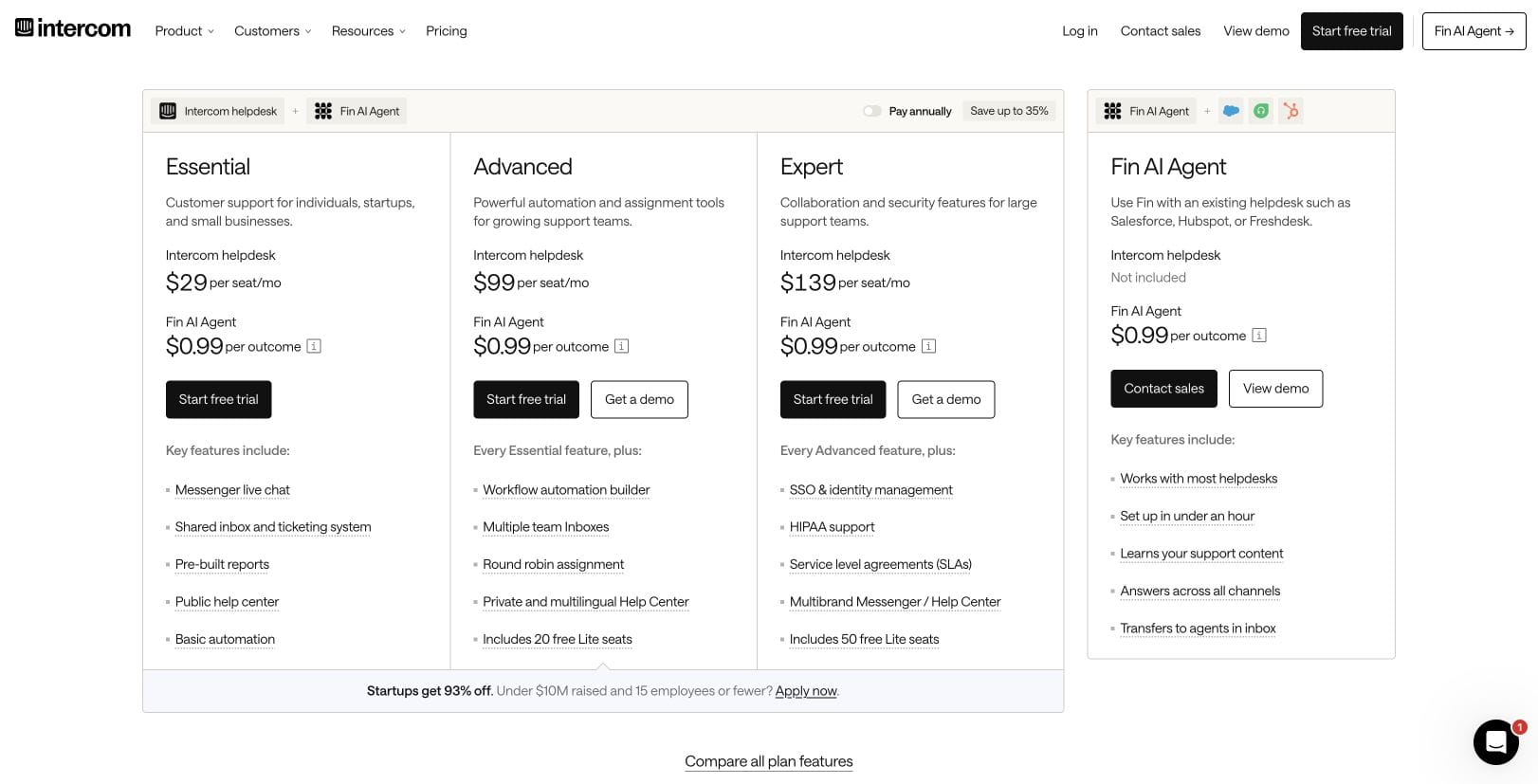
| Five support users | $15 total; unlimited seats | $195 at documented $39 per seat; $145 at live $29 display |
| Current HelpDesky offer | $9 for six months with 40OFF6, then $15 | Check eligibility and renewal of any offer |
| Base subscription difference | 92.3% lower than $195; 89.7% lower than $145 | Excludes AI, taxes and extras |
| Difference during $9 offer | 95.4% below $195; 93.8% below $145 | Base subscription only |
| AI charge | Connected provider usage; choose a supported provider and model | $0.99 per service resolution or qualifying Procedure handoff |
USD, checked 11 October 2026. Monthly billing throughout. HelpDesky pricing; Intercom’s documented seat rates; live Intercom prices. The lower Essential display was visible with annual billing switched off; its eligibility and renewal terms are unverified. These are not percentage savings on the complete support bill.
HelpDesky includes the help centre and support tools in that flat fee. This example uses five full support users, not five employees who may need different access. Fin can also be bought for an existing helpdesk, so an existing customer should compare their actual arrangement rather than automatically adding Intercom seats.
What does each AI billing unit mean?
With a provider key, you generally pay for the model activity used to produce an answer. Input includes the instructions, question and supplied context; output includes generated tokens. Longer exchanges, repeated attempts and additional processing can increase the bill even if a customer eventually needs a person.
Intercom’s outcome definitions include resolutions where no further help is requested after the last AI answer, and configured Procedure handoffs. The current rate for those service outcomes is $0.99. Voice and sales qualifications have different pricing, so this article excludes them.
Do not assume every incoming conversation creates a chargeable resolution. Equally, do not assume only an explicit customer confirmation counts. Read the current definition against the particular service you plan to enable.
How do you estimate a provider bill?
Use a named model and its actual billing rates, then count all relevant calls. For a transparent illustration, Google lists Gemini 2.5 Flash-Lite standard paid text input at $0.10 per million tokens and output, including thinking tokens, at $0.40 per million on its API pricing page.
Assume each attempted conversation consumes 8,000 input tokens and 1,000 output tokens across all its model calls. That gives $0.0012 in model tokens per attempt: 8,000 × $0.10 ÷ 1,000,000, plus 1,000 × $0.40 ÷ 1,000,000.
This is a rate illustration, not a measured HelpDesky workload or confirmation that this exact model appears in your current selector. Google is a documented HelpDesky provider; verify the available model before using its rate in your budget. Substitute your actual model, measured token totals and any additional provider charges.
| Illustrative monthly activity | Model token subtotal | Fin service outcome subtotal |
|---|---|---|
| 200 attempts; assume 100 billable outcomes | $0.24 | 100 × $0.99 = $99 |
| 1,000 attempts; assume 500 billable outcomes | $1.20 | 500 × $0.99 = $495 |
| 5,000 attempts; assume 2,500 billable outcomes | $6 | 2,500 × $0.99 = $2,475 |
At 40,000 input and 5,000 output tokens per attempt, the same illustrative rates produce $6 per 1,000 attempts instead of $1.20. That sensitivity matters: a headline token price is only useful when you know how much context and output the workflow uses.
Where is the break even point?
Let A be your complete monthly provider bill, R the chargeable service outcomes, and B the competing platform subscription you actually need. Compare $15 + A with B + $0.99 × R. Include additional products on the appropriate side instead of hiding them in a percentage.
At 500 chargeable outcomes and the observed five seat base of $145, the latter total is $640. HelpDesky’s software cash total is lower in that scenario if A is below $625. At the documented $195 base, the corresponding threshold is $675. These thresholds compare cash charges only, not the value of different features or human effort.
Use the $15 regular fee for an ongoing decision. The six month offer reduces the HelpDesky side by $6 during that period. For the broader package differences, see our five person Intercom comparison; for staffing and maintenance costs, use the support software budget guide.
What control does your own key give you?
HelpDesky’s Ask AI requirements list OpenAI, Anthropic, Google and xAI. Your own account provides visibility into usage and access to the supported provider and model choices. You can evaluate a different supported model when the balance of cost and answer quality changes.
Assign someone to monitor that account and understand its billing controls. Google’s Cloud Billing guidance distinguishes alerts from supported spend caps: an alerts only budget does not automatically stop usage. Do not promise a hard cap simply because a budget number appears on screen.
Outcome billing can also offer controls. Intercom documents usage reminders and hard limits for Fin. Whichever model you choose, check what happens when the limit is reached and keep a working route to human support.
How should you test the economics?
- Use the same representative questions, including unclear requests and missing documentation.
- Record all attempted activity, billable outcomes, provider costs and human follow up separately.
- Review answer correctness and source support before counting a question as resolved.
- Repeat after changing the model or materially expanding the knowledge base.
Crisp’s official video below discusses reducing AI agent costs while maintaining support quality. It is useful vendor context for an evaluation, not evidence for the rates or model performance in our examples.
Frequently asked questions
Does bringing my own key mean building my own chatbot?
Not necessarily. A support platform can provide the interface and workflow while your connected provider supplies the model. Check what the product implements and what remains your responsibility.
Can unsuccessful answers still cost money?
Yes, model processing can incur provider charges even when the response is not useful. Include unsuccessful attempts and repeated calls in the measured usage.
Is a conversation the same as a resolution?
No. A conversation is an interaction; a billable resolution follows a vendor’s definition. Neither should be treated as a fixed number of tokens.
Does HelpDesky include unlimited free AI?
No. Pro’s unlimited conversation allowance is a platform entitlement. The AI provider bills usage separately through your own key.
Will a more expensive model always save support time?
No. Test relevant questions and review the remaining human work. Model price alone does not establish accuracy, useful answers or customer satisfaction.
Which charging model should a small team choose?
Start with HelpDesky if its support workflow fits and you value a modest flat fee with direct provider choice. Choose using measured costs and results; a more expensive service may justify its bill when its capabilities reduce work you otherwise need to do.