
Which free help desks include AI answers, and what are the limits?
Free AI support can mean recurring credits, a limited trial or a free platform with separate model costs. Here is how to compare the allowances fairly.

Allowances checked on 3 October 2026 using the vendors’ published pricing and documentation. HelpDesky publishes this guide. This is a buying comparison, not a performance benchmark.
Which free AI support options are worth comparing?
Start by separating the help desk subscription from the AI entitlement. A product can have a free inbox and a paid AI service. Another can include a small recurring AI allowance. A third can provide the interface while a separate model provider charges for generating answers.
The shortlist below covers those three models. It is not an exhaustive ranking, and a message credit is not equivalent to a conversation or a successful resolution.
| Option | Free allowance or access | Does it renew? | Main qualification |
|---|---|---|---|
| tawk.to AI Assist Hobby | 100 AI message credits; one AI agent | Monthly credit allocation | Several replies can consume several credits within one customer conversation |
| Tidio Lyro | 50 AI conversations | No, the free quota is used once | Ongoing renewable AI capacity requires a paid package |
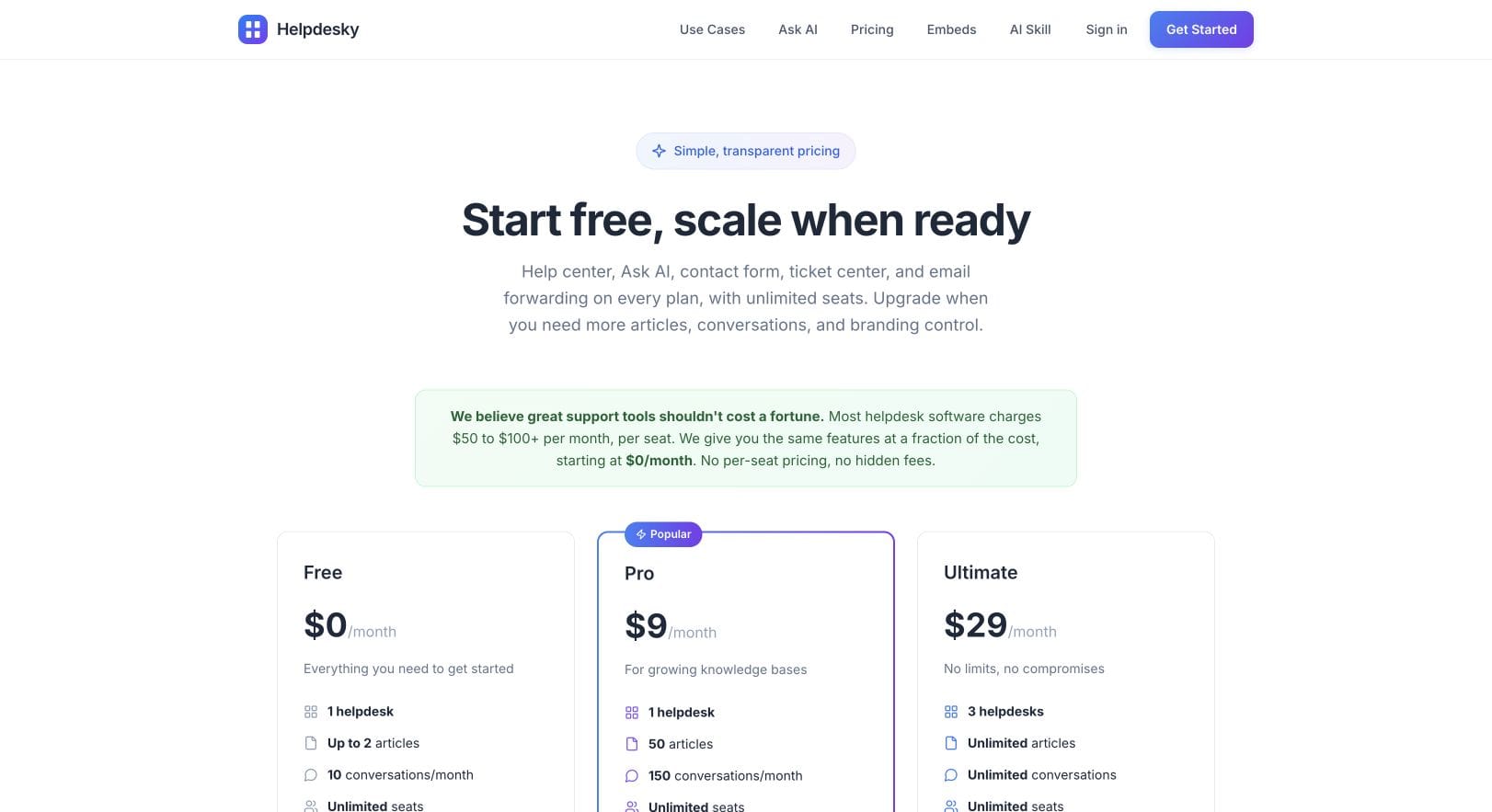
| HelpDesky Free | Ask AI access; one helpdesk, two published articles, ten monthly conversations | The plan has monthly conversation capacity, not bundled model credits | Your connected AI provider bills usage separately |
Sources: tawk.to’s AI billing terms, Tidio’s Lyro quota explanation, HelpDesky’s current plans and the Ask AI provider requirements.
When does a recurring free AI allowance make sense?
A recurring allowance is useful when you want a small ongoing service rather than a short evaluation. tawk.to’s Hobby plan is an example. Its billing documentation counts each AI message as one credit, including Smart Reply and AI Commands. That means the allowance should be assessed against replies sent, not simply the number of customers who contact you.
For an illustrative workload, 20 conversations requiring four chargeable AI messages each consume 80 credits. The arithmetic is 20 × 4, not a prediction of how your visitors behave. Leave room for longer exchanges and other credit consuming activity. A hundred credits is not evidence that a hundred customer problems will be resolved.
The tawk.to credit exhaustion guide says existing conversations can continue after credits run out, creating excess usage deducted from the next balance. The AI will not join new conversations until credits become available again. Purchased credits are available only on paid AI Assist plans, so do not assume that Hobby supports occasional top ups while remaining free.
tawk.to’s official video below covers credit counting, fallbacks and other common AI Assist questions. It provides the vendor’s explanation of its own system, not independent evidence of answer quality.
Is a free trial enough for an ongoing support service?
A trial can answer whether a tool suits your customers. It cannot establish that the same capacity will be available free next month. Tidio’s documentation says Lyro stops once its nonrenewable 50 conversation allowance is exhausted; a paid Lyro package provides a renewable quota.
Its unit is also different from a message credit. Lyro can reply several times within a conversation, while the first response in a new thread counts towards the quota. The documentation says 15 minutes of inactivity closes a thread, so a returning visitor may begin another chargeable conversation. An immediate handoff does not consume the quota.
Use a limited trial deliberately. Prepare representative questions before turning it on, record what was answered correctly and reserve capacity for testing the cases that matter most. Avoid spending the whole evaluation on repeated greetings or questions that your customers never ask.
Does HelpDesky Free include free AI usage?
It includes access to AI features, not a promise to cover your model bill. The Free plan lists a help centre, widget and support tools with unlimited seats. Its two article and ten monthly conversation limits make it a small starting point. More articles or conversation capacity require a different plan.
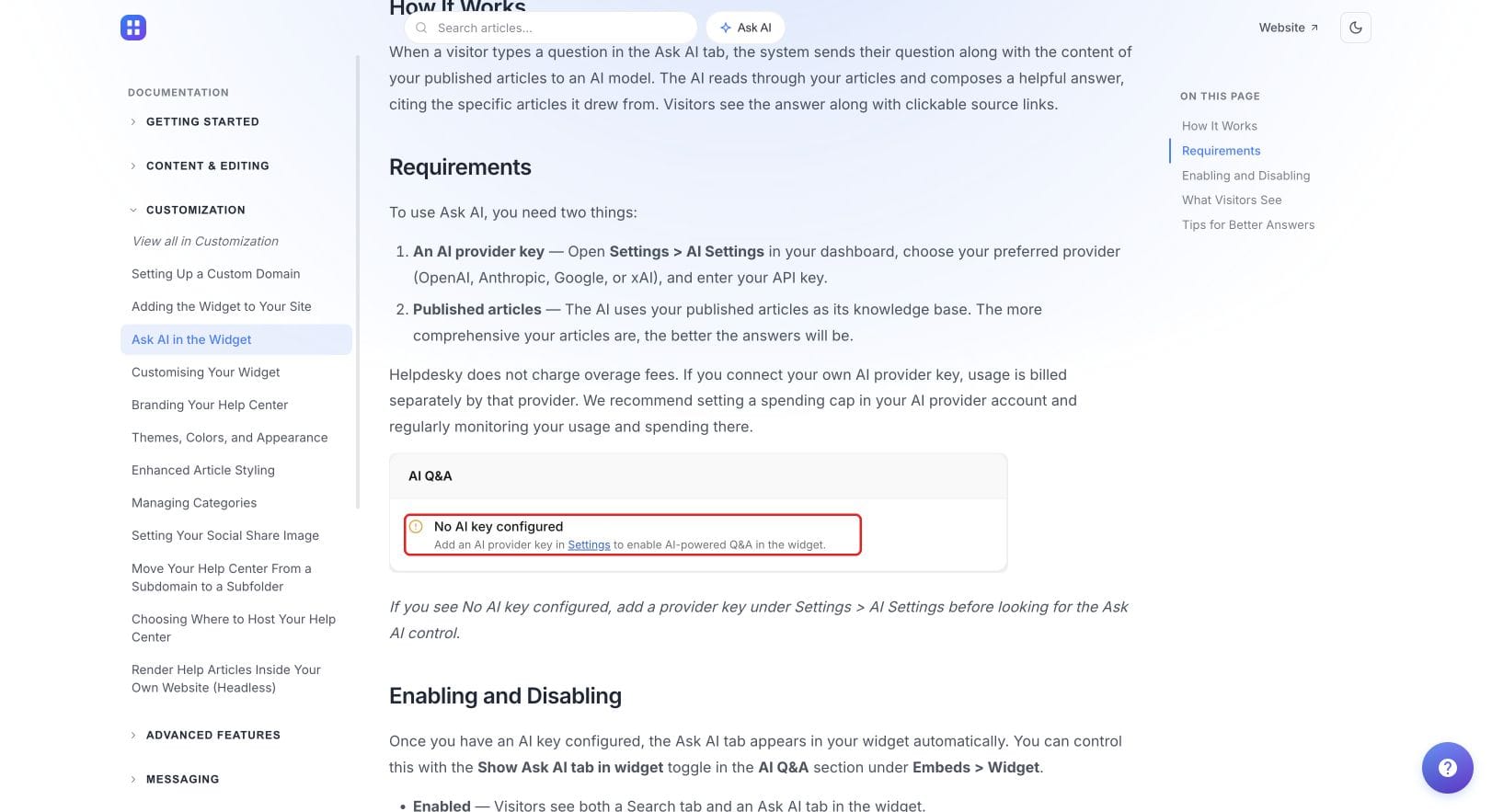
Ask AI uses your published articles and requires your own AI provider key. HelpDesky’s documentation states that the provider bills usage separately and recommends spending controls and monitoring. Do not count the plan’s ten conversations as ten prepaid model calls; they describe different parts of the service.
This model can suit a team that wants to choose its provider and evaluate the help centre alongside AI answering. If your requirement is strictly zero cash outlay for AI, it is not equivalent to included credits. If you need a larger content library immediately, two published articles may also be too restrictive.
How should you compare allowances fairly?
Write one line for each shortlisted product: unit counted, allowance, renewal rule, exhaustion behaviour and who bills you. Keep human inbox usage, AI messages and automated conversations in separate columns. Mixing them produces a reassuring total that does not describe any actual plan.
Then estimate your own workload using a small representative sample. Include a straightforward question, a follow up, an unclear request and a case that must reach a person. Measure the relevant unit for each product. A reply that sounds confident but gives the wrong answer should not count as a successful outcome in your evaluation.
Before enabling AI for all visitors, decide how customers can reach you if it stops answering. Test that route from the customer’s side. You want a useful next step, not a dead end after the allowance runs out. Avoid putting private customer information into an evaluation unless your handling arrangements permit it.
If you are comparing the whole monthly bill, our small SaaS support software budget guide covers subscriptions, usage and staff time. If the question is how many colleagues can participate, use the separate unlimited seat help desk comparison. Neither headcount nor subscription price tells you the AI allowance by itself.
Which model should a small SaaS choose?
- For a small recurring included allowance: consider Hobby, then check whether its message budget and remaining features fit your support workload.
- For evaluating Lyro: treat the free quota as a test and decide what you would pay after it ends.
- For a help centre with your own AI provider: evaluate HelpDesky, while allowing for external usage costs and the plan’s content capacity.
Choose using the customer experience you can sustain after the free allowance has been used. A clear answer, reliable source material and a working route to a person matter more than the largest number on a pricing card.
Start with your real support questions. Try HelpDesky’s help centre and support tools, then assess Ask AI with a separate provider budget.
Frequently asked questions
Are AI messages and AI conversations interchangeable?
No. One conversation can contain several messages, and each vendor defines its own counting rules. Compare a representative workload using those rules rather than comparing the headline numbers directly.
Does Tidio’s free Lyro allowance reset every month?
No. Its free 50 conversation quota does not renew. A paid Lyro package is needed for a recurring allowance.
Can I buy extra tawk.to credits while staying on Hobby?
The current credit guide limits credit purchases to paid AI Assist plans. Check the upgrade requirement before relying on top ups.
Can an unlimited seat plan still limit AI?
Yes. Seats describe team access. They do not promise unlimited AI replies, unlimited customer conversations or unlimited spending with a connected provider.
Should I test only questions that the AI can answer?
No. Include missing information and requests that need a person. Check that the service handles those cases appropriately rather than inventing a response.
How often should I review the free allowance?
Check it during the evaluation and again as real usage grows. Assign someone to monitor consumption and the fallback route, especially before a launch or another expected increase in customer questions.