
What should you check before letting an AI agent publish help articles?
A practical acceptance checklist for AI help article publishing: verify access, review boundaries, saved changes and recovery before expanding your workflow.
Sources checked on 22 October 2026. The checks below are suggested acceptance criteria, not a claim that we tested every AI client or permission setting.
What should you ask a help centre vendor to demonstrate?
Imagine an agent turning a release brief into a help article while a support lead updates the existing instructions. The buying question is whether both people can trust the result: correct content, correct destination and no lost edits.
Ask for a small demonstration using harmless sample content. These six checks give the trial a clear outcome.
| Check | Evidence to ask for |
|---|---|
| Identity and scope | The account, workspace and permissions used for the action |
| Draft boundary | A saved draft that is not publicly available |
| Publication approval | The exact content and destination shown before release |
| Concurrent editing | A stale edit being rejected or safely reconciled |
| Revocation | A disconnected agent failing its next authorised test request |
| Recovery | A documented route to withdraw or correct the article |
Record which checks are enforced by the platform, which depend on the AI client and which remain your team's procedure. That distinction matters more than a broad promise of human oversight.
Whose permissions does the agent inherit?
Ask whether the connection uses an individual staff account, a shared administrator or a dedicated service identity. Then inspect the actual access attached to that identity. The person approving a connection may have broader permissions than the writing task needs.
For a first trial, choose the smallest practical scope. An agent preparing a product FAQ does not automatically need permission to change team membership, send customer replies or alter the website's address.
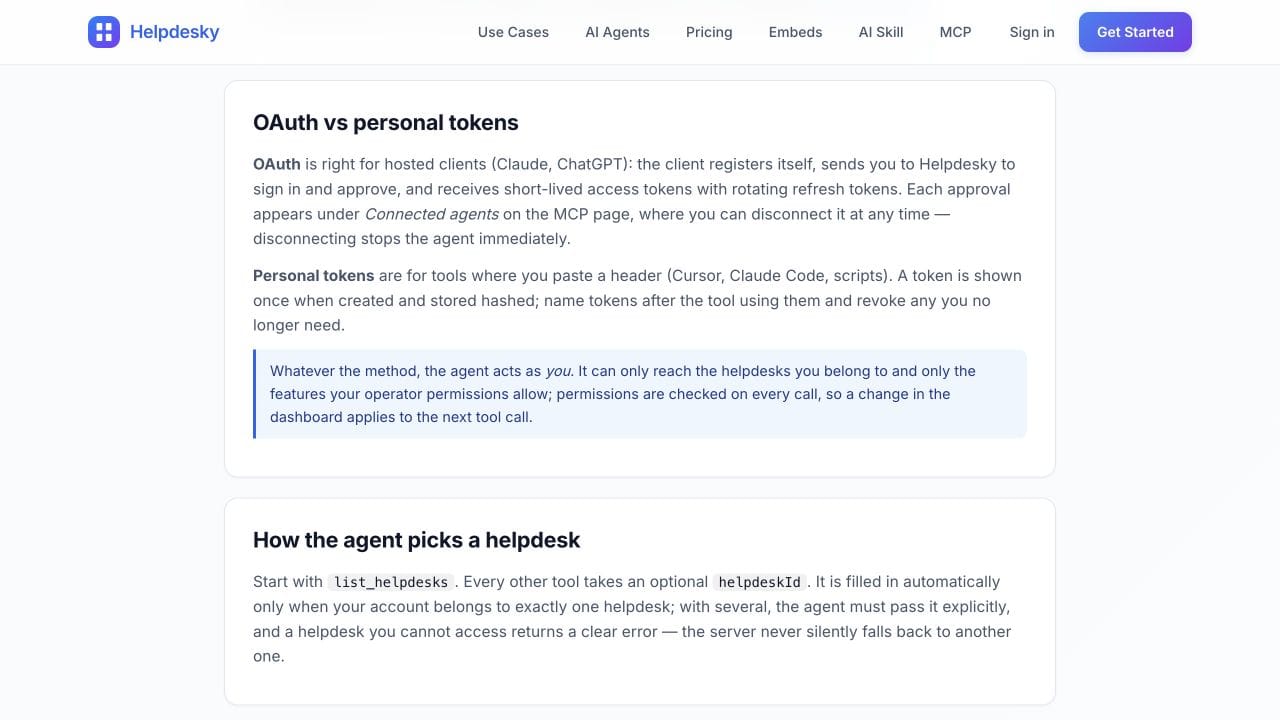
The HelpDesky MCP overview says calls use the connected operator's permissions. A staff member without article permission cannot publish through MCP. It also describes explicit helpdesk targeting and rejection of access to a helpdesk the operator cannot use.
Those are useful boundaries to evaluate. They do not, by themselves, establish a separate permission that allows drafting while forbidding publication. If that separation is essential, ask the vendor to show the exact role or control that enforces it.
Is a draft default the same as an approval gate?
No. A default describes what happens when an option is omitted. An approval gate determines who can authorise the change to public content. Your trial should establish both.
HelpDesky's article tool documentation says new articles are drafts unless publication is requested. It also exposes a separate publication action. This supports a draft and review process, but should not be described as a mandatory independent reviewer workflow.
Ask what happens when an agent receives “write and publish this”. Does the platform block publication until another person approves, does the client ask for confirmation, or can the agent proceed using the connected account's access? Choose a setup whose answer matches your team's needs.
The MCP tools specification recommends human oversight and confirmation interfaces, while leaving the interaction model to implementations. A tool being labelled destructive is therefore not proof that every client will display the same approval screen.
What should a reviewer see before release?
A useful review presents the proposed article, its source material and its destination together. The reviewer should not have to reconstruct the change from an agent's summary.
- Accuracy: Do the instructions match the current product and its limits?
- Changes: What was added, removed or rewritten compared with the saved article?
- Scope: Is this the intended help centre, category and public address?
- Customer impact: Are links, screenshots and examples appropriate for the audience?
- Release decision: Who approved this particular version, and what should happen next?
For example, a feature announcement may omit a limitation that matters to existing customers. The agent's fluent wording does not resolve that gap. Keep the article in review until the product owner supplies the missing fact.
If you are deciding how to package that repeatable editorial process, our Agent Skills and MCP comparison explains the different roles of instructions and live tools. For the account side of the decision, consult the HelpDesky team roles reference when choosing who should connect the agent.
What happens if another person edits the article?
Include a concurrent edit in your trial. Let the agent read a sample article, change that article separately, then ask the agent to save its earlier revision. The acceptance criterion is that newer work is not silently lost.
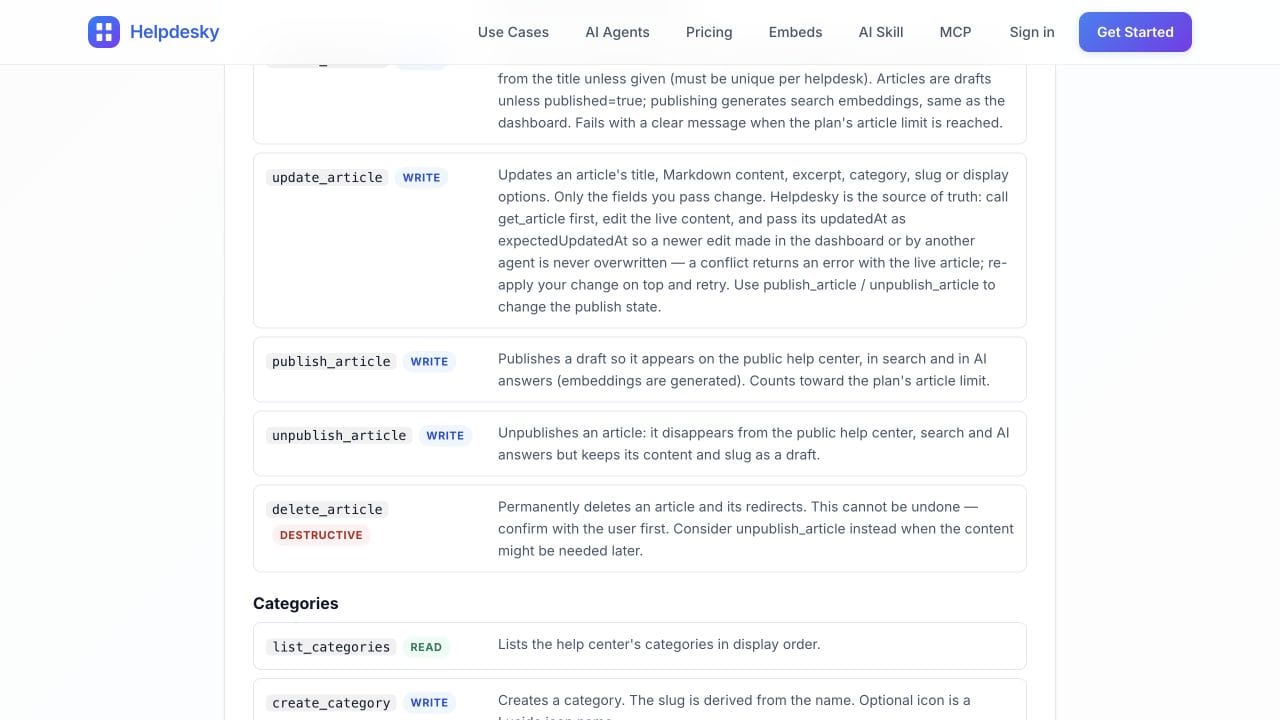
HelpDesky documents an expectedUpdatedAt check for article updates. A conflicting update returns the current article instead of overwriting it. Ask your chosen agent to demonstrate that it uses this protection and reviews the conflict.
Also test an interrupted request. If the client loses the response after saving, it should inspect the current record before creating another article. Keep the article ID and intended slug in the workflow so a retry can find the original.
This is a process recommendation, not a claim that every connector automatically prevents duplicates. A successful request and a verified saved result are separate pieces of evidence.
Can you stop the agent and recover its changes?
Identify the person responsible for disconnecting access. The HelpDesky overview says revoking a token or disconnecting an agent stops access on the next call. Test that boundary with a harmless request before relying on it.
Revocation stops future access; it does not undo a published article. Ask separately how to remove incorrect content from public view and how to recover the previous wording.
HelpDesky documents unpublishing as retaining the article and slug in draft form. It describes deletion as permanent, including associated redirects. Do not assume unpublishing restores an older version, or that every content change has a general undo history.
Agree a recovery procedure before the trial: retain the approved source, save the previous text where needed, nominate a reviewer and decide when withdrawal is preferable to immediate correction. A visible wrong answer may need urgent attention even if the underlying article remains recoverable.
Where does MCP fit into this decision?
MCP provides a connection through which an agent can use tools. The useful buying decision is about the complete workflow around those tools: access, review, release and recovery.
Anthropic's introductory video explains the protocol behind this connection. It provides background for the evaluation, rather than demonstrating HelpDesky's publishing permissions or proving a particular client's approval behaviour.
Watch Anthropic's MCP introduction if the player is unavailable.
For the wider platform shortlist, use our MCP server selection guide. Return to this checklist when a vendor's feature list looks promising and you need evidence that the publishing process suits your team.
Can a small team evaluate this without a large subscription?
HelpDesky Free includes one workspace, unlimited seats, 15 published articles and 15 monthly conversations. Pro costs $15 monthly for one workspace with unlimited seats, articles and conversations. The current code 40OFF6 gives $9 monthly for six months, then $15.
Connected AI client charges and usage for HelpDesky features using your own AI provider key remain separate. Supported provider and model choice gives you control over that account and visibility into its usage bill. Check the selected provider's spending controls before assuming any budget setting is a hard stop.
Start with one low risk article and one named reviewer. Expand the workflow only when the trial gives you clear answers about publication, conflicting edits and recovery.
Frequently asked questions
Does connecting an agent approve every publication?
Authentication gives the connection access within its permissions. Your team still needs to define which work is authorised and verify how the client and platform handle approval.
Can a draft default prevent all accidental releases?
No. A client may explicitly request publication. Check whether the system enforces a separate publication restriction when that is a requirement.
Should the first trial use an administrator account?
Prefer the narrowest account access that supports the test. If broader access is necessary, document why and inspect the additional actions it makes available.
Does disconnecting the agent remove its articles?
Do not assume so. Access revocation and content recovery are different operations. Inspect what has already been saved or published and handle those records separately.
Is unpublishing the same as restoring an old version?
No. Taking an article out of public view does not establish that its earlier text is restored. Verify revision recovery or retain an approved copy yourself.
What evidence should we keep from the trial?
Keep the sample brief, reviewed draft, intended destination, publication decision and observed results of the access and recovery checks. Record any behaviour that still depends on your chosen client.